Reporting a Hometax Bug: From Open Redirect to CVE and CWE
· dev· 6 min read
A coworker, SH, ran into some odd behavior in the Hometax app while working. “Shouldn’t we report this?” I said — and they told me they don’t bother with tedious stuff like that. So I decided to file it myself.
Getting ready to file it, I found myself looking into things like “where do you even report this?” and “I’ve heard of CVE, but what’s CWE?” Here are my notes.
What the vulnerability was
Hometax uses an app link to open a specific screen in the app from a web link. Tap a link in a text or a notification and it passes through a Hometax domain to open the Sontax app. The link looked roughly like this:
https://m.sefd.hometax.go.kr/appLink/?linkUrl=<destination>Whatever address sits in linkUrl gets loaded straight into the app’s webview. The problem was that the app didn’t properly validate whether that value was actually a tax-service domain. Drop an external address into linkUrl and the Sontax app opens as normal — with a completely unrelated external site rendered inside it.
This is called an open redirect: a trusted domain forwarding a user anywhere at all, with no validation. On its own it can feel like a “so what,” but the scary part is when it meets phishing.
- The link’s host is genuinely a tax-service domain (
m.sefd.hometax.go.kr, a subdomain ofhometax.go.kr). To anyone who checks the domain and relaxes, it looks perfectly legitimate. - But what finally loads could be an attacker’s fake login page.
- And it opens inside the government’s own app, not a plain browser, borrowing all the trust that shell carries. This is especially dangerous for a webview-based app like Sontax: with no address bar, an external page looks just like a native app screen.
Taxes and refunds are reliable phishing bait to begin with. Wrap them in “a government-domain link opening a government app screen” and even a cautious person could reasonably fall for it. The fix, on the other hand, isn’t complicated: parse linkUrl, check that its scheme is HTTPS and its host is in a whitelist of allowed tax-service domains, and refuse to open anything else.
The official “resolved” reply
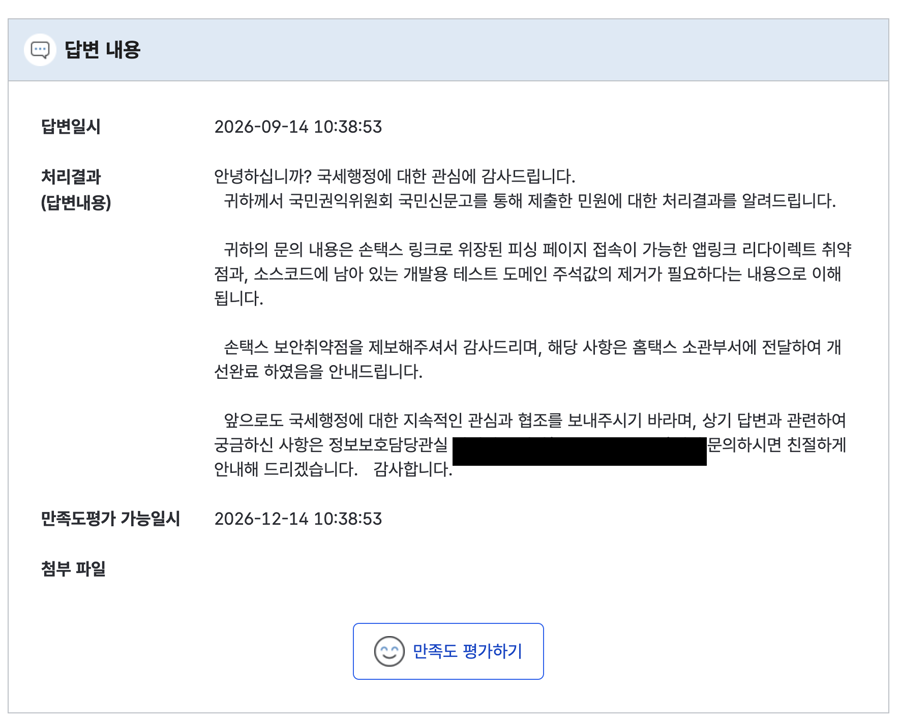
The National Tax Service’s “resolved” reply after I filed through e-People. The officer’s name and phone number are redacted. (The reply itself is in Korean.)
Where to report a security vulnerability
When it came time to file it, the first hurdle was figuring out where. The three routes I looked into were these.
- National Cyber Security Center (NCSC, ncsc.go.kr) — handles cyber threats involving government and public institutions. Its site has a vulnerability intake form, so I filed the reproduction steps, cause, and impact there, and emailed the screen recording separately.
- e-People / Civil Complaints Portal (epeople.go.kr) — the government’s general complaints portal. It’s not a security-specific channel, but because this was a problem with one specific agency’s service (Hometax), I filed here too. A complaint filed this way gets routed to the responsible agency, and in fact it was assigned to the National Tax Service, which sent back a reply. For getting an agency-service issue in front of that agency, this route was the surest.
- KISA’s Boho.or.kr & KrCERT (boho.or.kr) — I didn’t use it this time, but it’s worth knowing. KISA runs a program that takes reports of new vulnerabilities in software products and rewards them (a bug-bounty-style scheme). It fits vulnerabilities in widely-used products and solutions better than an issue in a single agency’s web service.
In short: for a public-sector agency’s service, use a route that reaches that agency (e-People, NCSC); for a vulnerability in a widely-distributed product, KISA is the right door. For a private company’s service, check that company’s own official security-reporting channel first. For the record, I filed with both NCSC and e-People, but the “resolved” reply came back through e-People (handled by the National Tax Service).
CVE and CWE
Writing the report meant citing references, and that’s how I first came to distinguish CVE from CWE. I’d used Trivy to scan container images for vulnerabilities before handing them to clients on SI projects, so CVE was familiar — but CWE was something I looked at properly for the first time here.
CVE (Common Vulnerabilities and Exposures) is a unique ID assigned to each individual vulnerability found in a specific product or version. Log4Shell, for example, carries the number CVE-2021-44228. It’s close to a case number: “this one door was unlocked.”
CWE (Common Weakness Enumeration) is a dictionary that classifies vulnerabilities by type. The open redirect I reported falls under CWE-601. It’s not an individual incident but a category: “the mistake of leaving doors unlocked.”
So a single CVE (a concrete incident) usually gets tagged with one or more CWEs (the type of weakness behind it). Conversely, what I reported is a CWE-601 type but didn’t get a CVE number: CVEs are generally issued for distributed or sold software products, so they rarely attach to a one-off service run by a single agency like this.
Real CVEs classified as open redirect (CWE-601) include Directus’s CVE-2024-28239 and caddy-security’s CVE-2024-21497. Here’s how one weakness type (a CWE) ends up with many instances (CVEs), drawn out:

One “type” like CWE-601 (Open Redirect) has many CVEs (individual “instances”); a vulnerability with no CVE number, like this Hometax case, still belongs to the same type (1 : 0..N). Severity is gauged separately with a CVSS score.
Looking around, there turned out to be several more of these classification and scoring systems.
- CVSS (Common Vulnerability Scoring System) — the standard for scoring a vulnerability’s severity from 0.0 to 10.0.
- CWE Top 25 — MITRE’s annual list of the “most dangerous software weaknesses.”
- OWASP Top 10 — a list of the risks that show up especially often and severely in web applications. Widely used as a practical checklist.
- CAPEC (Common Attack Pattern Enumeration and Classification) — a dictionary of attack patterns: how weaknesses actually get exploited.
- CISA KEV (Known Exploited Vulnerabilities) — a catalog of vulnerabilities confirmed to be actively exploited, used to set patch priorities.
Even just telling CVE, CWE, and CVSS apart gives you the frame: what kind of mistake (the CWE type) broke where (the CVE instance) and how dangerous it is (CVSS).
Wrapping up
It wasn’t a big find, and it wasn’t even mine — I just reported what a coworker happened to notice. Still, having gone through the experience once of not shrugging off a “that’s weird” and instead routing it to the right channel, I think I’ll hesitate less next time. When I write code that takes a link and sends someone somewhere in a service of my own, I think I’ll remember to validate the destination. And when something looks off, I won’t let it slide — on top of the tools I already use, I’ll have an AI take a pass at it too.
As an aside: sadly, there was no reward — just a single “resolved” reply from the tax service. Then again, that isn’t why I did it.